Plan the cleaning
The practical system includes a place to dry the bottle, a way to inspect the seal and a realistic plan for replacing any filter you add.
Care instructions are model-specificCleaning should be part of the buying comparison, not a task discovered after delivery. A compact carbonator may still require a bottle brush, drying space and occasional attention to a nozzle or pressure-release assembly. If those steps are awkward in your kitchen, they can become a stronger reason to stop using the machine than any shortcoming in its feature list.
Start by reading the care section of the exact manual. Bottle material, cap construction and removable components determine what can be washed and how. General advice cannot authorise hot water, dishwasher cycles, chemicals or disassembly that the manufacturer prohibits. The guidance below is a planning framework, not a substitute cleaning procedure for every machine.
Separate the parts and their rules
A bottle, cap, removable infuser and machine housing may all have different instructions. Do not assume a dishwasher-safe bottle means its cap can go beside it, or that a removable part may be dismantled further. Where seals can be removed for cleaning, follow the documented sequence and refit them correctly before use.
For the appliance exterior, follow the manual on disconnecting power where applicable and wiping the surface. Never immerse a machine unless its instructions explicitly permit that treatment. Do not push brushes, pins or other objects into a carbonation nozzle to clear a suspected blockage. Stop operation and seek model-specific support if flow or pressure release becomes abnormal.
- Read the bottle, cap and machine care instructions separately.
- Use only the permitted water temperature, detergent and tools.
- Inspect the bottle, attachment and seals while cleaning.
- Let washed components dry as directed before storage.
- Keep washing water and cleaning agents away from gas connections.
- Stop use if damage, abnormal operation or persistent contamination is apparent.
Drying is a space requirement
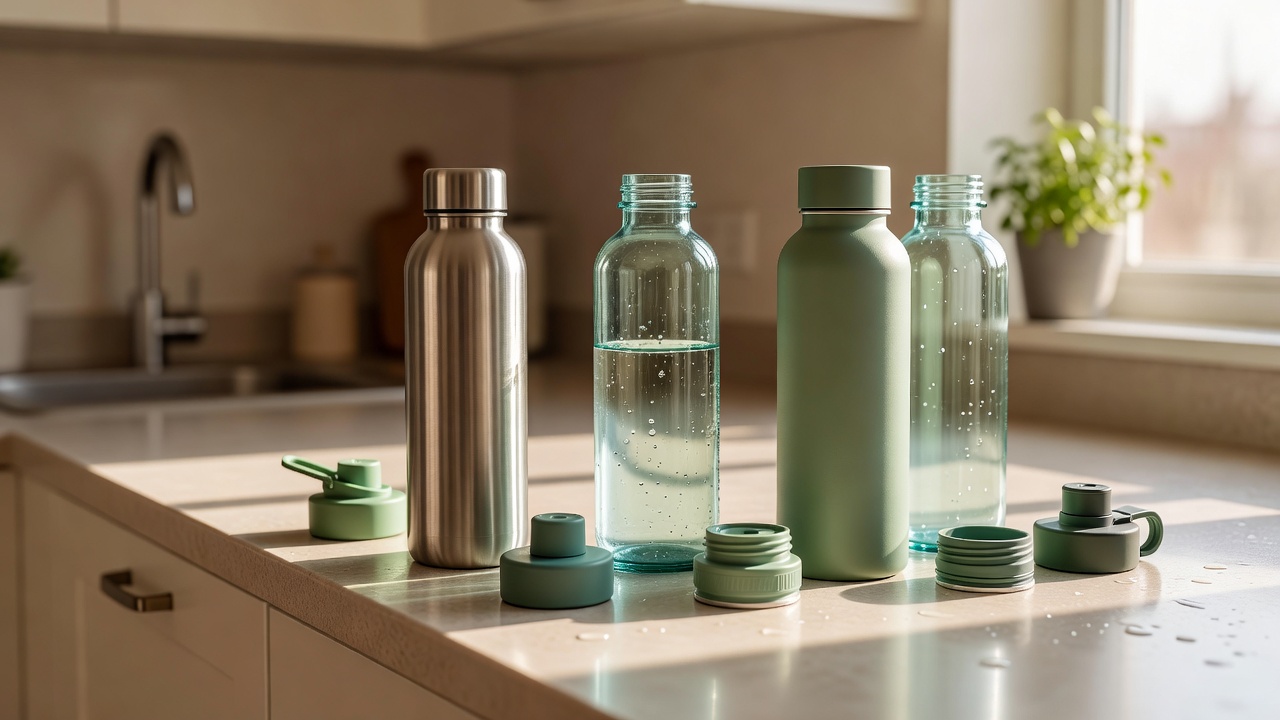
A narrow bottle that stands upright while wet may dry slowly. Check whether the manufacturer recommends inverted drying, a rack or another arrangement. Keep caps off during drying where instructed, and avoid trapping moisture by immediately sealing washed components. Plan for a clean drying position that does not block the sink or require precariously balancing the bottle.
Flavoured drinks add another layer of work. In water-only machines, add flavour after carbonation and removal as directed. In equipment approved for other liquids, follow the additional cleaning steps for the components that contact the drink. Sugar, pulp and other residues should not be treated as though a quick water rinse necessarily removes them.
Identify the water problem first
Filtration is optional for many households with a suitable drinking-water supply. Begin with information from your local supplier or relevant public-health authority. Taste, hardness, sediment and specific contaminants are different issues. A cartridge that improves one does not necessarily address the others, and carbonating water is not a substitute for making unsafe water safe.
If you are concerned about a private well or a known contamination issue, obtain appropriate water testing and qualified advice. Follow any local drinking-water advisory. Do not infer from clearer appearance, reduced odour or stronger fizz that a water source has become safe. This guide provides equipment-selection context, not a diagnosis of your water quality.
Certification needs to be read at the claim level. NSF/ANSI 42 concerns specified aesthetic effects, while NSF/ANSI 53 addresses specified health-related reduction claims. NSF/ANSI 58 applies to reverse-osmosis systems, and NSF/ANSI 401 covers specified emerging-compound reduction claims. A reference to one of these standards does not mean every substance associated with the standard is reduced by every certified product.
| Option | What to verify | Ongoing friction |
|---|---|---|
| Filter jug | Exact cartridge claims and compatibility | Refilling, refrigerator space and cartridge changes |
| Tap-mounted filter | Tap fit, rated flow and stated reduction claims | Clearance, flow changes and replacement access |
| Under-sink system | Installation requirements and certified system configuration | Cartridge access, leaks and service work |
| Reverse osmosis | Certified claims, supply requirements and wastewater information | Membrane care, consumables and possible storage needs |
Read the listing, not just the logo
Match the exact system and cartridge combination in a recognised certification listing. A logo on a box is not enough to establish the particular reduction you need. NSF and the Water Quality Association provide certification resources; the United States Environmental Protection Agency also offers general drinking-water information. These are useful starting points, but local requirements and water conditions still matter.
Brands such as BRITA, PUR, ZeroWater and BWT offer different systems and cartridges. Their names alone do not tell you which contaminants a particular product reduces or how long a cartridge will last in your household. Compare the exact documentation rather than transferring a claim from one cartridge family to another.
Put filter changes on the same ledger
Follow the specified replacement interval, capacity limit and any other replacement conditions; use the earliest applicable limit in the instructions. Calendar reminders can help, but do not replace attention to system behaviour or a public-health advisory. A flow change, for example, is not a reliable universal indicator that every type of cartridge is still effective.
Include filters in the annual cost only if they are part of the setup you actually intend to use. Add installation or service costs where relevant. Reverse-osmosis reject water and electricity for powered systems may also matter. Do not hide those costs inside a generic “water is free” assumption.
The easiest care routine is the one your household can repeat correctly.
Before committing, describe a normal week: prepare water, chill it if desired, carbonate, wash, dry and replace consumables when due. If that sequence does not fit the available space and time, choose a simpler arrangement. Read the running-cost guide to include the maintenance items explicitly rather than treating them as an afterthought.